
Reviewed · KILIMANJARO CLIMBS
6 Days Machame Route Kilimanjaro Trekking
Kilimanjaro rewards patience, and this Machame trek is built for it. You climb through multiple habitats, sleep at camps at altitude, and then go for the summit at night when conditions are often best. I like the classic Machame route because it mixes big views with a smart acclimatization rhythm.
Two things I especially like: the trip includes everything needed for camping (mess tent, mattress, and cooking setup), and you get real mountain support with a professional driver/guide and porterage. A good bonus is that pickup is offered, so you are not stuck figuring out logistics at the start.
One thing to consider is the summit day pressure. Day 5 is the most intense portion, with midnight to early-morning climbing over heavy scree toward Stella Point, so you will want to be mentally ready for a long, cold, step-by-step push.
In This Review
- Key Highlights to Know Before You Go
- Why the 6-Day Machame Route Is a Popular Kilimanjaro Choice
- Day 1: Rain Forest Trail to Machame Camp (5,400 to 9,400 ft)
- Day 2: Moorland, Heather Ridges, and Shira Campsite (9,400 to 12,500 ft)
- Day 3: Shira Plateau to Lava Tower (Shark’s Tooth) and Down to Barranco Hut (12,500 to 13,000 ft, then down)
- Day 4: Barranco Wall to Barafu Hut, Summit-Prep Views of Mawenzi and Kibo (13,000 to 15,000 ft)
- Day 5: Midnight Summit Push to Stella Point (18,600 ft) and the Crater Rim
- Day 6: Mweka Descent Through Wet Forest and Summit Certificates (10,000 to 5,400 ft)
- Money, Meals, and Support: What You Pay for at $1,930.42
- Packing Tips That Match Mud, Cold Nights, and Scree
- Fitness and Acclimatization: Is 6 Days Enough?
- Who This Trek Fits Best
- Should You Book This Machame Trek with Mafie Adventures?
- FAQ
- How many days is the Machame route trek?
- Where does the trek start and end?
- Is pickup offered?
- What is included in the price of $1,930.42 per person?
- Is climbing gear or a sleeping bag included?
- What is the cancellation rule?
Key Highlights to Know Before You Go
- Machame is the popular choice for good reason: big scenery, varied habitats, and a route many climbers already trust.
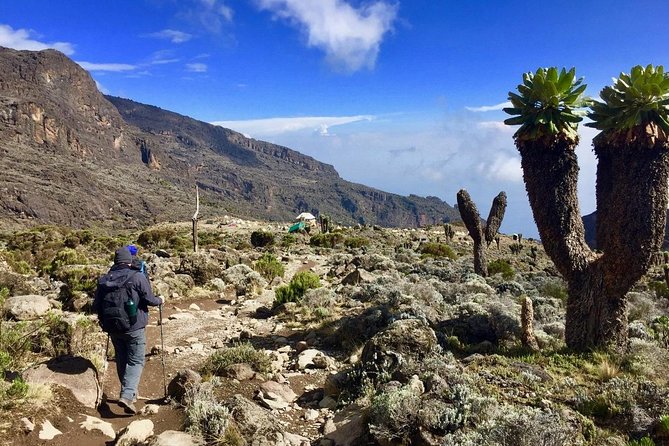
- Habitat variety in 6 days: rain forest, moorland, semi desert, alpine desert, and an “Arctic” feel at higher elevations.
- Names you will remember: Lava Tower (Shark’s Tooth) and Barranco Wall are standout landmarks on the way up.
- Acclimatization is built in: you climb higher, then come down to sleep lower on key days to help your body adapt.
- Summit strategy centers on Stella Point at 18,600 ft, where the sunrise can be unforgettable if weather cooperates.
- Support and food are part of the value: meals are included across the trek, plus camping gear and rescue fees.
Why the 6-Day Machame Route Is a Popular Kilimanjaro Choice
The Machame route is a favorite for a reason: it gives you a steady sense of progress while also changing the scenery in a way that keeps your brain busy. In plain terms, you are not just climbing one long beige slope. You move through different climate zones as altitude rises, and that variety makes each day feel distinct.
This plan also tends to work well for many people because it is shorter than the longest itineraries, but it still includes critical acclimatization steps. That means you spend time at elevation, you get your body used to it, and you avoid the mistake of rushing straight to the summit without adaptation.
At the same time, 6 days is still tight. If you are a slower hiker or you know you typically need more recovery time, you might feel the pace more than you expect. You do not need to be an elite athlete to do Machame, but you should be honest with yourself about how your breathing and energy usually behave on steep, high-altitude days.
More Hiking Trips in Moshi
- 8 Days Kilimanjaro Hike via Lemosho Route
★ 5.0 · 39 reviews - Private Kilimanjaro Hike 7 Day Lemosho Route
★ 5.0 · 60 reviews - Best Kilimanjaro hiking day trip tour with Kilinge Adventures
★ 4.5 · 54 reviews
Day 1: Rain Forest Trail to Machame Camp (5,400 to 9,400 ft)
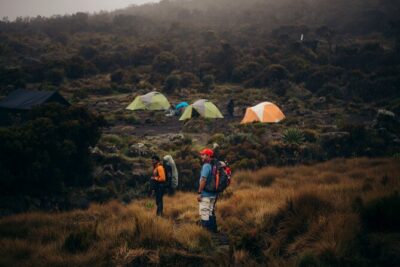
Day 1 starts at Kilimanjaro National Park and immediately shifts you into a rain forest setting. You begin around 5,400 ft and climb up to about 9,400 ft, with roughly 11 km of hiking and a 5 to 7 hour window. The drive from Moshi area to the park gate is listed as about 50 minutes, then you hike uphill on a winding trail.
This is the day where the mountain can feel wet and slippery. Lower down, the trail can turn muddy, so gaiters and trekking poles are not “nice to have.” They help you keep stable footing and save your knees on uneven ground.
The tradeoff on Day 1 is straightforward: you are climbing while your body is still adjusting to the mountain atmosphere, so keep your pace controlled. You want to finish feeling like you could do a little more, not like you already maxed out for the day. When you camp at Machame Camp, you are setting the stage for the more exposed terrain ahead.
Day 2: Moorland, Heather Ridges, and Shira Campsite (9,400 to 12,500 ft)
Day 2 continues the climb from about 9,400 ft to 12,500 ft, with around 5 km and 4 to 6 hours of hiking time. That might look shorter on paper, but it is not a “light day” in disguise. The route leaves the rain forest glades and moves into moorland.
You will cross small valleys and walk along steep, rocky ridges with heather. Then you turn west onto a river gorge. This mix of footing can be tiring, even if the distance is modest.
You end at the Shira campsite. This is an important step in the acclimatization pattern because you are gaining elevation, but you are also moving into a different type of landscape where breathing can feel different. The practical goal here is to rest well, eat enough, and hydrate. Summit success is not just about willpower later. It is also about what you do on days like this, when nothing glamorous is happening yet.
Day 3: Shira Plateau to Lava Tower (Shark’s Tooth) and Down to Barranco Hut (12,500 to 13,000 ft, then down)
Day 3 is one of the more memorable days because it connects the Shira Plateau climb with landmarks that make the trek feel real and specific. You start around 12,500 ft and go up to about 13,000 ft, then focus on climbing lines toward major waypoints.
The route heads east up a ridge, passing junctions toward the peak of Kibo, then you change direction toward the south east, aiming for the Lava Tower, known as Shark’s Tooth. After that, you reach a junction leading up toward the Arrow Glacier area at about 16,000 ft.
Then comes a key acclimatization win: you descend to Barranco Hut at about 13,000 ft. Even though your end elevation is similar to your start, the day still stresses your body in a productive way. You get higher exposure during the day, but you lower down to sleep.
This day is a solid reminder of how altitude really works. You can feel fine on paper, but your body adapts based on how it experiences the thin air. The combination of a higher push and a return down for the night is one reason this itinerary is chosen so often.
More Kilimanjaro climbs:
- 7 Days Kilimanjaro via Machame route affordable price
★ 5.0 · 110 reviews - Kilimanjaro Airport taxi to/from Moshi town/Arusha town
★ 5.0 · 60 reviews - 6 Days Climbing Mount Kilimanjaro Machame Route
★ 5.0 · 40 reviews - 7-Day Machame Route Kilimajaro
★ 5.0 · 28 reviews
Day 4: Barranco Wall to Barafu Hut, Summit-Prep Views of Mawenzi and Kibo (13,000 to 15,000 ft)
Day 4 climbs from about 13,000 ft to roughly 15,000 ft and is longer, with 9 km and 8 to 10 hours of hiking. You leave Barranco and tackle a steep ridge, passing the Barranco Wall.
This is the day where trekking rhythm matters. When the terrain gets steep, it is easy to speed up early and pay for it later. The best strategy is slow and steady, using poles on ridges and keeping your breathing calm.
You move into the Karanga Valley campsite, then connect to the Mweka Trail junction. From there, you push up to Barafu Hut. The trek’s “South Circuit” is completed here, and you are in summit-prep mode.
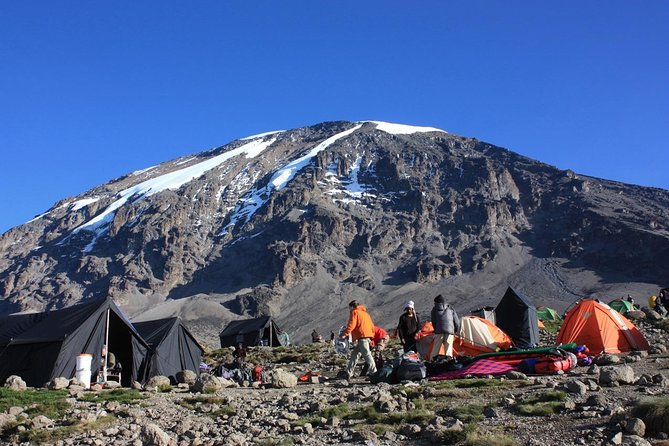
At Barafu, you also get major viewpoints over Mawenzi and Kibo. This matters more than it sounds. When you see the summit landscape clearly, you can mentally break down what is next, even though the next day is still brutal. Camp, dinner, and rest become the main tasks. You are conserving energy, not performing.
Day 5: Midnight Summit Push to Stella Point (18,600 ft) and the Crater Rim
This is the day people remember, and also the day that tests everything. You leave very early, in the midnight to 2 a.m. range, and you climb toward the summit between the Rebmann and Ratzel glaciers. You move in a northwesterly direction and ascend over heavy scree.
The described route heads toward Stella Point on the crater rim. Physically, scree slows you down and drains energy because every step is both uphill and unstable. Mentally, it is relentless because the ground feels like it is always the same level until it suddenly is not.
At Stella Point, around 18,600 ft, you pause for a short rest and, if weather cooperates, you get a chance at the most dramatic sunrise of your hike. Then you continue onward and down later in the day, with the itinerary listing a descent back toward about 10,000 ft.
The big takeaway: you need a pacing strategy that avoids panic. The hardest part is usually not the highest height. It is the late-stage exhaustion that hits after hours of low-speed, high-effort climbing. If you keep your pace controlled, you give yourself a better chance to finish strong.
Day 6: Mweka Descent Through Wet Forest and Summit Certificates (10,000 to 5,400 ft)
Day 6 is a release valve. You start after breakfast, descend down to the Mweka Park Gate, and receive summit certificates. The hike is listed as about 4 hours total, with around 10 km of descent and rain forest habitat at lower elevations.
This is also where conditions can turn messy. Lower down, it can be wet and muddy, so your feet and legs will appreciate gaiters and trekking poles again. The good news is that descent does not carry the same altitude pressure as ascent, but it can still hurt if your legs get overloaded.
Clothing-wise, shorts and t-shirts may be enough for lower elevation walking, but keep rain gear and warmer layers handy because weather on the mountain can shift fast. Once you reach the gate and get your certificates, the mountain adventure ends with the kind of satisfying final step that feels official and real.
Money, Meals, and Support: What You Pay for at $1,930.42
At $1,930.42 per person, you are not just paying for a guided walk. You are paying for the infrastructure that makes a high-altitude trek possible.
Here is what is included in the package you have described:
- Camping equipment: mess tent, mattress, and cooking equipment
- Accommodation across the trek nights
- Meals: 5 breakfasts, 5 lunches, 5 dinners
- A professional driver/guide plus porterage
- Parking fees and rescue fees
- All taxes/VAT
- Admission ticket listed as free for the trekking days
That matters for value because Kilimanjaro costs add up in pieces. If sleeping gear, meals, and staffing are handled for you, you can focus on your health and your hiking rhythm instead of chasing last-minute logistics. Also, rescue fees and rescue coverage being included is a comfort point. Mountain travel is serious travel.
What is not included is also important to plan for. Climbing gear and sleeping bag are available for rent, and bath towels are not included. Tips are also not included, and those are part of the real-world cost on many guided treks.
If you are budgeting, think of this as a “staffed expedition” rather than a bare-bones hike. The professional team and porters are a huge part of why many people finish feeling cared for, not just moved along.
Packing Tips That Match Mud, Cold Nights, and Scree
Your packing list should match the conditions described across the route.
Bring:
- Gaiters for muddy trail sections (Day 1 and Day 6 are both flagged for slippery conditions)
- Trekking poles for balance on ridges and for descent comfort
- Rain gear, plus warmer layers for cold early mornings and high altitude
- Comfortable layers you can adjust, since Day 1 rain forest can feel different from alpine desert terrain later
- Enough water strategy for day-to-day hydration, even though the tour covers logistics on the camp side
Check rentals:
- Climbing gear is not included, but renting is available
- A sleeping bag is not included, but renting is available
Also plan for the small extras:
- Bath towels are not included
- Personal items are not included (travel insurance, visa fees if relevant, and souvenirs)
- Tips are not included, and they are typically the part you decide based on service
If you want one simple sanity check, do this: pack for wet plus cold, then pack for steady walking. If your gear choices help you stay dry and stable, you will feel better on the summit day grind.
Fitness and Acclimatization: Is 6 Days Enough?
This route is built around acclimatization, with one of the main patterns being climb higher during the day, then sleep lower on another day. Day 3 is a good example: you go up during the day toward higher points, then descend to Barranco Hut for the night.
That said, 6 days is not automatically “easy.” Day 4 is long, and Day 5 is the hardest. If you walk fast and you recover well, 6 days can work. If you walk slowly, you might benefit from more days to protect your energy and breathing.
A practical mindset is to treat each day as a step in a ladder, not as a race. Keep your pace controlled on steep ridges, and give your body time to adapt to altitude.
Who This Trek Fits Best
This Machame 6-day plan is a strong fit if:
- You want a route with major scenery changes over the span of a week
- You are comfortable with a long summit-night push, or you are willing to prepare mentally for it
- You want guided support plus porters, meals, and camp infrastructure handled
- You like having clear, named landmarks to focus on, like Shark’s Tooth and Stella Point
It might be a tougher choice if:
- You know you struggle at high altitude and usually need extra time to recover
- You get discouraged by very early starts and long hours on your feet
- You do not plan to bring the right stability gear for mud and scree
Should You Book This Machame Trek with Mafie Adventures?
If your goal is a classic Kilimanjaro experience with a route many climbers choose for its mix of views and habitats, this Machame 6-day plan makes a lot of sense. The included setup is substantial: camping gear, staff support, and meals reduce the stuff that can distract you from the real job, walking safely at altitude.
The strongest reason to book is the structure. You get habitat variety, an acclimatization rhythm, and the summit plan centers on Stella Point for a sunrise moment when conditions allow. The strongest reason to pause is Day 5. If you are not ready for a midnight to early-morning climb over heavy scree, you may feel that strain.
For the team factor, I like that the coordination is hands-on, with names like Erastus showing up as a coordinator in people’s accounts, and lead guides like Matthew, Oliver, and Benjamin appearing in summit teams. That kind of consistent leadership tends to matter when weather shifts and your body feels unpredictable.
My call: if you are prepared for a serious summit day and you pack for wet and cold, book. If you want a gentler experience, consider adding days on your itinerary so acclimatization has more room to work for you.
FAQ
How many days is the Machame route trek?
It is listed as 6 days approximately.
Where does the trek start and end?
The meeting point is Kilimanjaro International Airport, and the activity ends back at the meeting point.
Is pickup offered?
Pickup is offered.
What is included in the price of $1,930.42 per person?
The package includes camping equipment, parking fees, rescue fees, accommodation, all taxes/VAT, a professional driver/guide, porterage, and meals (5 breakfasts, 5 lunches, and 5 dinners).
Is climbing gear or a sleeping bag included?
No. Climbing gear and a sleeping bag are available for rent.
What is the cancellation rule?
This experience is non-refundable and cannot be changed for any reason.
If you tell me your hiking pace (fast, average, slow) and the month you plan to go, I can suggest whether 6 days feels like the right fit or if you should consider stretching the itinerary.
More Hiking & Trekking in Kilimanjaro
- 8-Day Small-group Lemosho Kilimanjaro Summit Trekking
★ 5.0 · 186 reviews - Mountain Kilimanjaro Day Hike
★ 5.0 · 102 reviews - Private Full Day Hiking Experience to Marangu Route
★ 5.0 · 61 reviews - 4 Days Mount Meru Trekking
★ 5.0 · 55 reviews
Just posted around Kilimanjaro
- Mount Kilimanjaro 6 days – Machame route★ 4.0 · 5 reviews
- 5 days Serengeti Wildebeest Migration Safari★ 5.0 · 3 reviews
- Lemosho Route★ 5.0 · 21 reviews
- Mount Kilimanjaro 7 Days – Machame Route★ 5.0 · 5 reviews
- Amazing 4 Days Safari 3 Nights: Tarangire, Ngorongoro, Serengeti★ 5.0 · 6 reviews
- 9 Days – Best of Tanzania Safari★ 5.0 · 4 reviews
- Tanzania Safari and Kilimanjaro Climb Multi-Day Experience★ 5.0 · 3 reviews
- 7 Days Cultural and Wildlife Safari★ 5.0 · 5 reviews
Kilimanjaro Climbs, compared.
8-Day Small-group Lemosho Kilimanjaro Summit Trekking
Read our review →
5 Days Best of Tanzania Luxury Safari Northern Circuit
Read our review →
Climbing Kilimanjaro through 7 days Machame Route
Read our review →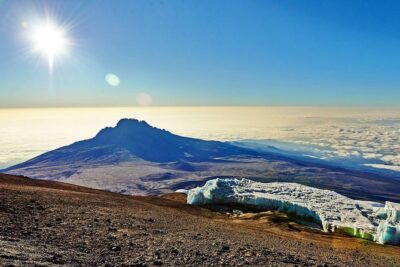
Browse the lists this tour appears in